Tuesday, February 2, 2016

Fitting Out A Newly Built Boat

Fitting out a new boat can be difficult and very very expensive.I have known people to buy $20,000 boats and then drop another $50,000 to $60,000 on refits before they even touch water.Well my boat will cost around $3500 for the completed bare hull and cabin. See my post "Spira International 27 Foot Boat Plans Build Costs".Im looking at another $2,000 for paint,finish,and interior,and roughly $2,000 for powering the boat.So what about electronics.This is a difficult one to put a price on.The one system that you want to be all new is the waste,water, and plumbing system.This could give you tainted water,flood your boat, and/or make it stink like a sewer,if old equipment is used.Pumps maybe ok with a good cleaning,but tanks and piping need to be all new.

Understanding Boat Plumbing and Water Systems

First,how will the boat be used?For the first two or three years,the boat will be trailered to lakes and coastal areas.Eventually,it will be used to do "The Great Loop Cruise". Knowing how I will use the boat and when I may need to make upgrades helps a lot.I can resell my old equipment, when I upgrade, to recoup some cost.To do this, I will have to buy decent quality reliable products and maintain them in as new condition as possible.Ive rarely ever had problems taking care of things.

 The Great Circle Route

Second thing,the power plant.Jeff Spira,the designer of my boat, recommends an outboard for power.I have some issues that make outboards a bit of a challenge to use as a means of propulsion.My area has a strict ban on two stroke outboards.That leaves me trying to find a four stroke with controls and gauges.Four strokes are a relatively new thing and used set ups are still fetching top dollar.I cant afford to pay around $10,000 for a 90 horsepower four stroke outboard set up.After consulting with Jeff Spira,he has approved the use of a sterndrive.These are plentiful in my area and cheap,relatively speaking.A good complete four cylinder 140 horsepower 3.0L Mercruise set up goes for between $1500 and $3000.

Third thing,I have a plan to cut costs,get most of the stuff I need,and possibly make a little money back.I will buy a donor boat that is complete and running good.I can find sterndrive boats in good operating condition between $1000 and $6000.Some even have twin sterndrives.That would give me a few options.1)Sell the extra sterndrive set up. 2)Keep the extra sterndrive set up as a back up. 3)Clean up both sterndrive set ups,sell them,and buy a completely new set up.My choice would be the 140 horsepower diesel Volvo Penta D3-140 sterndrive set up.These are hard to find on the used market and most are damaged.New they start out around $12,000.A new 3.0L Mercruise sterndrive set up runs $6000 to $8000.On rare occasions,they can be had for around $5000 to $5500,but come with a catch.They must be set up by a factory Mercruise service center.

Stern Drive Manuals

The donor boat.This is tricky depending on location or region.Most boats here are bow riders or water sport boats.All tho,its not unusual to find cuddy or cabin cruisers for really good prices.Beware that a lot of boats are not properly maintained, and thats the reason they are for sell.Of course, one can get lucky at times and buy a boat that barely needs anything to be back on the water.Look for soft spots in the transom and floor.If they are soft then the stringers and flotation foam have been compromised,and the boats structure has been compromised.This is a good negotiating point.It is really expensive and labor intensive prospect to gut a hull for transom and stringer replacement.

What can be used from the donor boat?This depends on what boat is decided on to be the donor.When building a boat you need everything.

Heres what I look for in a donor.
Power Plant-must be running with all controls and gauges.
Electronics-VHF,depth sounder,radar,gps,etc... in operating conditon.
Pumps-Wash down,bilge,fresh water,black water,and grey water.
Electrical-Batteries,inverter,charger,genset,breaker panel,fuse panel,switches.
Windows-I plan to build my own to fit my boats design.
Bimini Top and canvas-It wont fit the boat,but it can be modified and save some money.Resell is an option.
Interior-Its hard to reuse interiors but they can be modified to work.
Thru Hulls-Pure preference,but I want bronze if theyre under water,and stainless steel above water.Plastic ones crack and fail.
Anchor,Rode,Bow Pulpit,and Windlass-These can usually be modified to work.
Heads(Toilet)-These things are a pain,save yourself the headache,buy new.
Sinks,Faucets,Showers-If these are in good condition,I will use them.I prefer stainless steel.
Tanks and Plumbing-All new.This was discussed earlier in this post.
Cabinets-These can be modified to work.
Hatches and Vents-These can usually be reused as is.
Swim Platforms and Ladders-Modified they can work.New they are outrageously priced.
Air condition unit(s)-These can be reused without much change.Good insulation can help keep the cool in.
Heaters-These can be reused without much change.


There is other items that can be reused but this is the most common expensive items.Anything that isnt used can fetch good money on Ebay or Craigs list.

RVs,motor homes,travel trailers can provide some good stuff also.I wouldnt use parts from them on a full time cruiser.A weekend cruiser should be fine.However,nothing will be USCG or AYBC approved.

Boat Systems Handbook

Read More..

TrawlerFest Bay Bridge 2015

Once again I will be part of THE BOAT BUYERS SURVIVAL GUIDE at Trawler Fest-Bay Bridge. I really enjoyed  participating in the one at Trawler Fest Anacortes. I will also be teaming up with Yacht Designer Chuck Neville on the session: AN INTRODUCTION TO METAL BOATS

http://www.passagemaker.com/events/trawlerfest-baltimore-2015/
Read More..

August 10 to 19 Cleaning Dining Paddling Planning and Oh Yes Sailing Too

Not all sailing in this period.
One day was devoted to cleanup after the cruise, replacement of the last cherrywood batten to hold up the cabin liner after installation of the new screens in the salon (Thanks, Tony!) and topping up coolant in the engine.
One day we had a lovely dinner with Craig and Katherine of Sangaris at the Club. I accepted their invitation to crew for them on their passage back to Boca Raton, Florida this fall. I expect this will be about three to five days, to the Chesapeake. The start date is not yet set, but probably sometime in October. So the departure may be while Lene is vacationing with our niece, Yael, in Israel, which will require some cat sitting coordination.
Another day we visited Fran, an old friend, in Kent, CT.  I paddled her canoe around her lake; not sailing, but.....
Lene was somewhat reluctant to come with me and Bennett and Harriet for a week on "On Eagles Wings" in the Virgins at the end of next March, but consented. I always tell her the same thing and it usually turns out true: "For a good time, come with me!" And Bennett advised that he would drop off the guests he will have during the first of his two weeks aboard, in Charlotte Amalie Harbor on St. Thomas, rather than on Tortola, sparing us the ferry ride from our flights arrival on St. Thomas, USVI to Tortola, BVI. And more important to me, he has agreed to look into going back by boat from St, Thomas, USVI to Tortola, BVI via St. Croix, USVI. This simplifies our Customs process because we will already be in the USVIs. But the major benefits of the proposed route are first, that it provides for two somewhat longer than usual passages (40 to 50 miles) to and from St. Croix  and second, it will add a "new" island to my travels. The beauty of this route is that the passages have a lot of south and north in them, providing for beamy reaches in the prevailing trade winds from the east. I immediately got out my Puerto Rico and VI chart kit and plotted the courses and their lengths and did some preliminary scouting about the entrances to the harbors, anchorages, restaurants, and shore attractions on St. Croix. I enjoyed this very much and sent off an email to my companions with the fruits of my labor of love.
Also, I have blocked out a date in May 2016 for a lunch with Eve, who with her late husband, Selwyn, have mentored me in sailing. [The word "mentor" derives from a sea story; Mentor was a character in Homers Ulysses, who mentored Ulysses son during his long sea travels.] Eve now lives in Austin TX but is visiting New York and we will pick her up and drive her to lunch with Jim, who has sold his beloved "Aria." So, some bits of advance planning. "Failure to plan is planning to fail."
And I did enjoy three day sails, for a total of 10.25 hours. The first was with Lene and our artsy, facially hirsute friend Jeff, who took this self portrait: his reflection on one of ILENEs shiny dorades.

Wind varied from 5 to 15 knots. We headed up through Hart Island Sound, circumnavigated Execution Rocks counterclockwise, getting around green can 1 off New Rochelle, thence a rather straight shot back through the small passage off Kings Point to Throggs Neck and back to the mooring. A rain cloud to the west looked threatening but passed south of us.
Dinner at the Club was again excellent.

Next came a sail with Lene and our nephew, Mendy, visiting from Israel. Mendy has sailed with us several times including Maine and on Club cruises over the years, and he is stronger than an ox due to excessive workouts in the gym. He did all the pulling and winching. All I need do is train him a little better on which strings to pull, how far to trim them  and why to do so, and he will be an excellent sailor. But for the first two hours the wind was so light that we only made about two knots, though the wind came up at last and we got to 6.5 knots for the return. In hindsight, if we had left two hours later we would have had more fun.
The third sail was an Old Salts Wednesday and provided the best wind of the three. ILENE had a bye day. I sailed with Bennett, Brian, Mike, Morty and Clara on Ohana. Wind was at about 12 knots from the NE and we darted back and forth several times between Throggs Neck and the entrance to Manhassett Bay on near beam reaches, achieving a speed of up to 7.5 knots.
Here is Ohana taken from Deuce of Hearts, sailed by Mark, Richie, Mark and Marsha and Art and Carolyn, who sailed on Deuce of Hearts, we had twelve sailors in the cats roomy cockpit for the after-sail libation. Sunny warm and windy; what more can one ask for!

Read More..

January 3 9 SEVEN Lay days in Miami B each Zero Miles

Miami, including the separately incorporated city of Miami Beach, is the largest city on our trip, by far. It is very much like New York, except for the temperature. Chock a block high rises, crowded urban density, traffic and parking problems, construction blocking streets frequently, lots of high income and low income people, lots of culture and a heavy Hispanic and Jewish component of the population. And while there are lots of old folks like us
down here, there are also a lot of young people in Miami Beach. Possibly the similarities are because so many retired New Yorkers have moved here -- also a lot of Canadians.
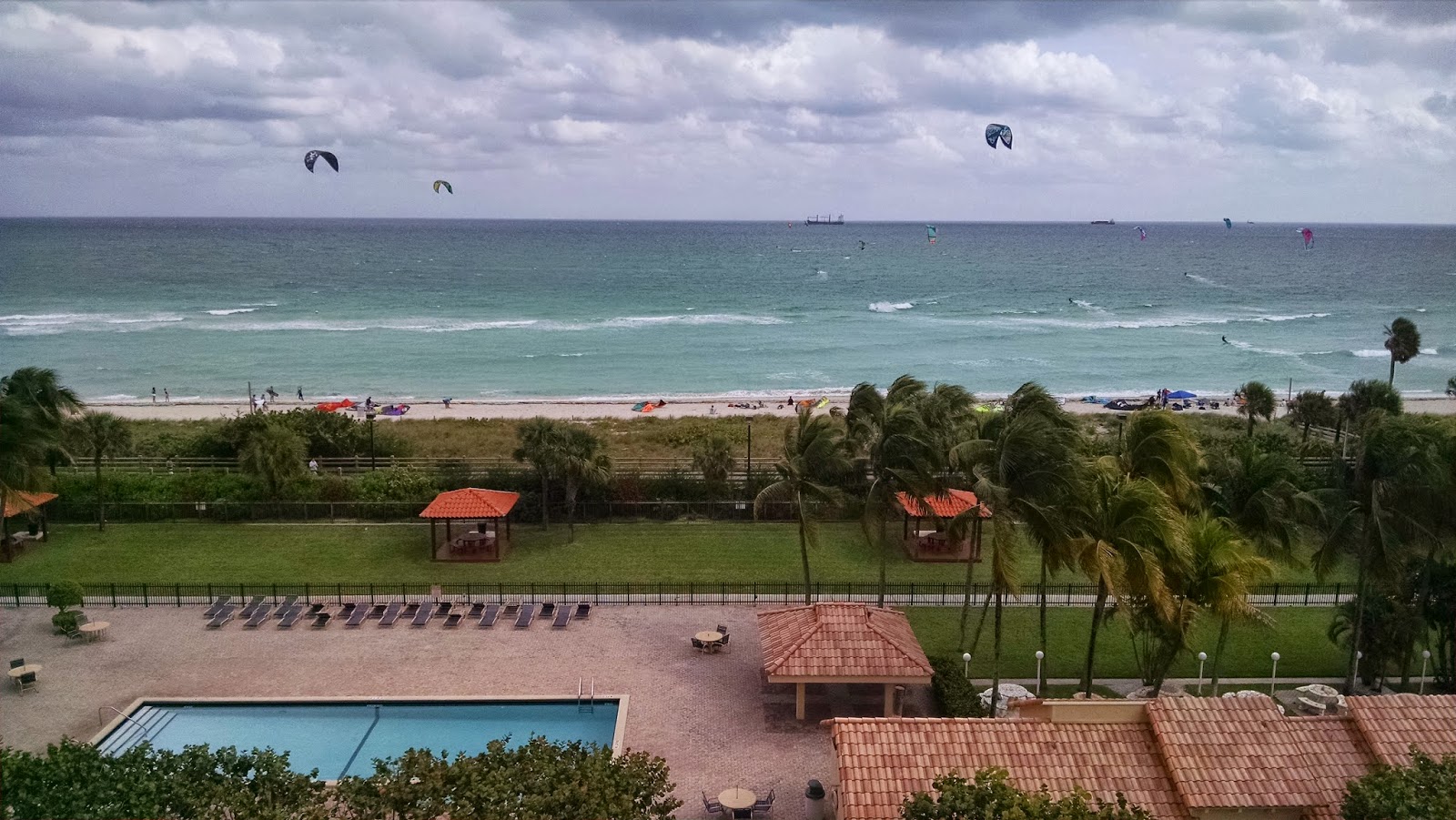
What made our stay so special -- and so long -- was the hospitality of our friends, Jerry and Louise. We swam in the surf and the pool of their condo. Those are kite board sails not gargantuan seagulls
We did our laundry there, took several showers and were ferried everywhere by auto. We had one dinner at their home, one with them and their friends, Harvey and Phyllis, at a new eclectic restaurant on Indian Creek Road at 27th Street.
From the left: Harvey, Phyllis, Jerry, Lene and Louise
and were invited with them to a lovely party of about forty people in another apartment in their building. We also had pizza with them one night and burgers at the highly rated B&B restaurant near us, which took two hours! So thge place is not highly rated by us.
They introduced us to stand up paddleboarding (SUP), which Lene frequently malaprops as "waterboarding;" Vive le difference! This was at Oleta State Park, several miles north of the city. Lene proved adept at this new (for us) sport. Im a slower learner. I had no problem climbing up onto the board, raising myself to my hands and knees and then to an erect position. But each of the ten times I did this, after a few strokes with the long paddle, I tilted it and fell off. Next time, Im told, I should keep my feet closer to the center of the board rather than toward its sides. And there will be a next time because we have rented an inflatable board (lashed to the starboard rails) and paddle until we get back here in about six weeks on the way home. Pictures of it, on board ILENE and in use, will be shown in next post. Jerry and Louise are also avid cyclists and Jerry is to lead his bike club on a 26 mile bike tour from Coconut Grove soon. One afternoon I rode shotgun with him in their car, calling out the 45 turns to be made during this bike trip.
Our anchorage was very close, walking distance, to many of the attractions of the downtown area in addition to both Publix and Fresh Market, a gas station, Chase Bank, dry cleaners and many restaurants.  The sights we visited were the dramatic Holocaust Memorial
and the Miami Beach Botanical Garden


 (very small but well done with about fifteen stops where you hear a recorded explanation about the fauna at that location on your cell phone).
Lene with giant banyon

We also saw The New World Symphonys hall, where they show movies for free on the huge white wall to people like us who sat on the lawn in front with a terrific audio system, and Lincoln Road Mall, a street closed to vehicular traffic and filled with shops and restaurants. We had lunh at Yuca, (Young Urban Cuban America). We are urban and American so meet only half the requirements, but they let us in and the food was good, including. for me, a  Media Noche sandwich which though called "midnight" they served for lunch.
The movie, shown for free en plein air on the large exterior wall, was "Hole In The Head", a Frank Sinatra comedy of the late 50s, which seemed uniquely appropriate to the setting because Frank played a down and out widowed playboy hotel owner in Miami Beach with a young son. The titles were aerial shots of the beach with banners towed by those beach banner planes spelling out such things as "Directed by FRANK CAPRA." It was not a great movie, saved by the performances of Edward G. Robinson and Thelma Ritter, but the experience was terrific.
At the near end of Lincoln Road, which is only about five blocks long, is a eighteen screen movie house in which we saw Unbroken, Top Five and Selma; a movie binge after a long drought along the way.
Boat chores accomplished during our stay here included sewing the sides of the zipper at the top of the stack pack to the sides of the bag. The stitches got torn out when I forget to fully open the zipper and raised the main with the electric winch; it is so strong that the sails leach pulled the stitches out, which is not god for the sail either!
I also had to take out the interior panels of the big lazarete to locate and fix the fresh water plumbing which is hidden behind the largest and lowest such panel. We noticed that the fresh water pump did not shut off after the faucet was shut off (because, due to the leak, pressure never built up) and Lene heard a flow of water after we turned that pump off. Yes, one of the short pieces of hose that I had attached last winter had come off, so the pump was pumping our fresh water into the bilge. I added a second hose clamp to each end of that two inch long piece of rubber hose and put back all the wood panels with the eighteen screws.
While the title of this post says we traversed zero miles, we actually did motor about 2.5 miles, from one side of Belle Island to the other.
First we went west along the north side of the the Venetian Causeway (the road connecting the row of six man made islands across the center of the chart) to its low opening bridge, at its Miami (left side) end, and then back east along the causeways southern side to the Miami Beach end (right side). We started a bit northeast of Belle Island, the easternmost of the string of man made islands that the causeway connects, to end up just south of Belle Island, just .4 miles away. We passed the Flagler monument, on the tiny island to the northwest of the blue (shallow spot in the middle of the right side of the chart.
Before the move we were about 100 yards west of the police dinghy dock (just below the small rectangle in the upper right) and afterwards we were almost half a mile south west. The reason for this change of venue was the weather.  The original anchorage was crowded making it difficult to put out enough chain to feel secure without bumping into nearby boats when swinging on the anchors. And with predicted winds gusting to 30 knots from the north, this problem would have gotten worse. On the south side, there is a lot more room between the boats and we were in the lee of the island which protected us from the strong winds.
Next stop: Dinner Key, known as Coconut Grove to land people, less than ten miles away.
Read More..

Monday, February 1, 2016

Header Photo Australian Vee Jay Dinghy


The previous header photo was of the Australian junior class, the Vaucluse Junior, aka the Vee Jay, or simply the "VJ". A 12-foot dinghy, the Vee Jay was originally designed in 1931 by Sydney boatwright Charles Sparrow to a design brief for a junior sailboat given to him by local sporting-goods store owner, Sil Rohu. It was a simple low-angle V-shaped hull, plank and frame construction, readily built by amateurs. The pre-World War II hulls had a small cockpit, similar to the North American Sunfish class.

What makes the class stand out was its transformation after World War II. The adoption of plywood in the late 1940s considerably lightened the hull and sailors started adding planks; the first plank (sliding seat to North Americans) added in the late 1940s but not coming into common usage until the 1950s. The second plank was added by the West Australians in 1958. The small cockpit disappeared, replaced by a self-draining surfboard deck. Combined with a small flat kite (shike), this junior dinghy had enormous power and speed in a breeze - unlike any junior trainer, before or since. (Historian Chris Thompson points out this Australian penchant, after World War II, to incorporate performance upgrades, even to supposed one-designs, even when all the previous models became immediately obsolete, was one of the main drivers in the evolution of Australian lightweight high-performance dinghies.)

The class collapsed in the 1980s under the hegemony and homogenization of fiberglass junior trainers (namely the 420).

I have taken most of my information and photos from the Vee Jay website. For those who wish to read more I would direct them to click on this link to their website. I would also like to thank Aussie, John Fairfax, for also filling in the history and providing photos.


Some additional photos.

The first design by Charles Sparrow was named Splinter. Deciding the first hull was too tender, Sparrow drew up a wider modified hull the same year named Chum from which commenced the VJ class. The original boats had a gunter rig.


Two photos of the simpler, 1930s hiking Vee Jay.


The squat sail plan was easily handled by lightweights in the typically strong Australian breezes.


To me, the most iconic photo of the Vee Jay, "Warren Nupier in Impala"


A promotional brochure with the Vee Jay at full crack, under kite.


This photo shows the final development of the Vee Jay before the class died out (the boom looks shorter with a straighter leech mainsail). There was a recent movement, documented on the Vee Jay website, of bringing back the class with a more modern sail plan, but that hasnt seemed to gain much traction.


A photo lifted from South Gippsland Y.C. of a restored Vee Jay racing at their 2015 Classic Wooden Dinghy Regatta. This is a one-planker, just for the skipper.


A 1950s video showing two juniors rigging, launching, and sailing their Vee Jay.


Ed. Sea Story

"As a young sailor, during the 1970s, I came across a Vee Jay on Annapolis Harbor. I saw this strange craft buzzing about the Harbor, two sliding seats, as we sailed our International 14 out to the starting area. On our way back after the racing, we encountered the same double sliding seat dinghy and sailors again. this time entwined in the fishing lines of two irate fishing boats, the air turning blue as the skipper was working desperately under his rudder. Inquiries on shore had the sailor as someone from the Australian embassy. I never saw him again; most likely the encounter with the fishing boats left a bad taste in his mouth.


And another sea story Ive pulled from the comments... from Northwest sailor Mike S.

"When I moved to Oz in 1965 with wife and daughter in tow, aged 21, I couldnt afford a boat, but someone was selling an old VJ with cotton sails and twin planks for only 10 quid, so I couldnt resist. It was a hoot albeit pretty rough around the edges, and as I didnt have a crew I jury rigged a trapeze (stitched my own canvas harness!) and sailed it singlehanded from the trap. Great fun on Lake Illawarra with steady 15-25 knot breezes every day. Its demise happened during a race, I got a crew and we sailed with the planks, some time during the race the wind piped up, and the old plywood started to open up, with us slowly sinking. We abandoned the boat, climbed aboard the rescue boat and left it to float to the shore. I went the next day and brought it up, but it was too far gone.....Had a metal daggerboard as I recall....

Click here for the post about the other Australian pre-WWII class, the Len Morris scow Moth.

Read More..

Sunday, January 31, 2016

May 17 18 St Marys to Solomons and Lay Day There 38 9 Miles

Seven am to 2 pm. We motor sailed down the St. Marys River and out of the Potomac. When we turned north in the Bay, we jibed the main, replaced the small jib with the Genoa, shut off the noise and enjoyed a wonderful beamy port reach, almost to the mouth of the Patuxent River. Here we are passing behind Point No Point Light, with plenty of depth for us.
We were doing seven plus, with favorable tide but the wind gradually diminished. The seas were glassy, indicating no wind, but the wind indicator, 63.5 feet above the water, showed some wind and we were moving at four knots, well above the rate of the tidal flow. But the wind gradually slowed, as did our speed,  to three knots, to two, and then we turned on the engine again. Solomons is only about ten miles from St. Marys as the crow flies, across the neck of land between the Potomac and the Patuxent, but almost four times as far by sea.
We had been to Solomons in 2006, when we docked at the Yacht Club. In 2012, we missed this port when we holed up during a windstorm. This time the threat of another thunderstorm caused us to moor ($30/night) at Zahnisers Marina, at the pencil point. It has been warm and sunny here by day.
We have use of their dinghy dock, showers, garbage disposal, swimming pool (though we did not use it) and loaner bikes. Solomons was bought by Isaac Solomon in 1865 to use as a trading and fish packing place. It was an island then but land fill at the far end attached it to the land. This place is chock full of 17 marinas, yacht Clubs and boat yards, with room to anchor in the other inlets up the eastern branches (the chart is unfortunately displayed with west at the top). We took showers, and used their bikes to go shopping and then to dinner at the eclectic CD Cafe. Our marina also has a barbecue area, (but we did not have charcoal). There we met the owners of s/v Baby B, a Saga 40, in great condition. Many people keep their boats here and drive for hours to enjoy them on weekends.
The first half of our lay day was for chores and then we split up: Lene got the solitude she sought and I visited the Calvert Maritime Museum (and Westmarine, where I managed to buy absolutely nothing!) It turns out that today was National Museum Day, which meant I saved the $9 senior admission fee. They have an outdoor nature station with information about local water grasses and wildlife, a great habitat for the resident otter, an aquarium, lots of stuff for kids, and lots of stuff for me too.
Ned, my docent for a guided tour of the Drum Point Light, which was moved here when it was decaying.

There are only two others of these screwpilers left. One is at the Chesapeake Maritime Museum at St. Michaels (across the Bay and our next stop) and one is still in use, near Annapolis. These screw pile lights are the only pretty ones in the Chesapeake, in my opinion. The wooden handle, below, is to pump up a 150 pound weight, which descends gradually during the next two hours, causing the heavy hammer to strike the outside bell through a removable panel between the windows, twice every fifteen seconds to warn during fog when the light cannot be seen.


ILENEs mast and forestays are visible behind the trees, to the right, from the top of the light.
And tthe museum has boats, of course, lots of boats. I learned that in the War of 1812 the British attacked cities along the Patuxent until they made a land dash from high up the river across to Washington DC, which they sacked. And the mouth of the river was home to three huge military facilities during WWII, for naval aviation, weapons development and amphibious assault.


They have several beautifully restored wooden pleasure craft, an interesting set of exhibits on wood carving (in the background behind this lovingly restored "dugout" fishing boat and with a display of mid century small power racing boats on the balcony),
the art of seam filling, blacksmithery and a large section about the excavation of fossils from the nearby riverfront cliffs. A very nice afternoon. The second nights thunderstorm passed at 1 am, without strong winds and with us safely on a mooring.
Read More..

The Florida Cricket Class A Missing Link

The Cricket class was a 15 foot, chined, V-shaped, catboat with wishboom that died out in the early 1960s. By that time the Cricket fleet was only found at the Miami Yacht Club and, given the small numbers at the demise, it is today, a forgotten class. But in digging through U.S. sailing history more comes out about the Cricket.

The Cricket class was designed sometime during the 1890s, in or around Atlantic City N.J, where it became extremely popular. Reports indicate hundreds were built and about one hundred were racing out of Atlantic City in 1900. It was, as far as I can determine, the earliest example of a chined, V-shaped sailing dinghy in the United States. More about the early development of the Cricket class (who was the designer? what prompted the design? when did the class die out in Atlantic City?)  has been hard to come by.

In the 1920s, when Northerners began to flock to the remote, but bucolic winter paradise that was Florida, the Cricket class was also exported in numbers from the New Jersey shores. It was reported that twenty five Crickets were shipped to southern Florida with most of them destroyed in the hurricane of 1926. The  Cricket class would rebuild in Miami and would form the core of the Southern Florida Sailing Association (later the Miami Yacht Club) when it was organized in 1928. The Cricket would become the boat to beat in the free-for-all under 150 sq. foot (sail area) class.

When, in 1931, Bill Crosby designed the Snipe for the Florida West Coast Racing Associations free-for-all Trailer class, he must have been mindful that his Snipe would initially be compared against the Cricket class, at least in Florida. Between the two, the hull design similarities are striking. It does seem that Crosby started designing his Snipe using the Cricket as a baseline and then added user-friendly features (a sloop rig with a high boom being the most notable one). The Snipe went on to international fame, the Cricket, to oblivion.

Some photos:

A smattering of classic Florida sailing dinghies; on the left, the Optimist Pram, behind the Pram, a Mothboat, in the center, a Cricket, with the other Cricket, bow on, in the foreground. Behind the Cricket is a Suicide class.


Crickets launching at Miami Yacht Club, late 1950s.


Crickets going upwind. In all three of the ones in view in this photo the crew are hiking using skinny hiking boards.


The closest we have to a set of lines for the Cricket was this one-design commissioned by St. Petersburg Yacht Club as featured in The Rudder, 1919. The lines look very close to a copy of the Cricket although the length for this one-design is a foot longer than the Cricket.


A blog post about an earlier New Jersey dinghy, the Philadelphia Tuckups of the 1870s can be found here.

Read More..
 
Nice Boat - Powered By Blogger